What is Chanta? Riichi Mahjong's Outside Hand Yaku (with Junchan)
Chanta and junchan are paired "outside hand" yaku in which every meld (and the pair) must contain a terminal or honor tile. Chanta lets honor tiles qualify; junchan keeps the hand pure of honors. Both share the same shape logic, which is why most riichi tables teach them together.
What is chanta?
Chanta (混全帯幺九, "mixed outside-of-1-9") is a riichi mahjong yaku scored when every meld and the pair contains at least one yaochuu tile — a terminal (1 or 9 of any suit) or an honor (wind or dragon). Closed it is worth 2 han; open it drops to 1 han. Because every group has to include a terminal or honor, sequences are restricted to 1-2-3 and 7-8-9 — the only sequences with a terminal in them.
What are chanta's exact conditions?
Three rules: (1) every meld — sequence, triplet or kan — must contain at least one terminal or honor; (2) the pair must also contain a terminal or honor; (3) chanta downgrades from 2 han closed to 1 han open like sanshoku-doujun and ittsu. Note: a hand of all terminals and honors with no sequences (every group a yaochuu triplet) is honroutou, a separate 2 han yaku that almost always coexists with chanta — honroutou drops the sequence requirement entirely.
Chanta vs junchan — what is the difference?
Junchan (純全帯幺九, "pure outside-of-1-9") is the honor-free version of chanta. It applies the same all-yaochuu rule, but every yaochuu must be a terminal (1 or 9) — honors are forbidden. Junchan is 3 han closed / 2 han open, exactly 1 han more than chanta in either form. The two are mutually exclusive: a hand with zero honors qualifies as junchan; a chanta-shaped hand with any honor tile in any meld or the pair is chanta only, not junchan.
What yaku does chanta or junchan stack with?
Both combine only with the limited set of yaku that respect their "every group is yaochuu" shape. Shared common stacks: riichi (closed), iipeiko (a closed pair of identical 1-2-3 or 7-8-9 sequences), sanshoku-doujun (1-2-3 or 7-8-9 across all three suits is a textbook chanta/junchan + sanshoku stack), toitoi (when the hand uses only yaochuu triplets), and the dora family. Chanta-only: honroutou (junchan forbids honors), yakuhai (junchan forbids honors). Pinfu is awkward — pinfu's non-yakuhai pair requirement makes pinfu + junchan impossible (junchan's pair must be a terminal pair), and pinfu + chanta needs an inert honor pair (e.g. a non-seat, non-round wind). Incompatible: tanyao (forbids terminals and honors).
When should I commit to chanta or junchan?
The trigger is a starting hand heavy in 1s, 9s and honors — typically four or more yaochuu tiles already in hand with reachable 1-2-3 or 7-8-9 shapes. Commit to chanta when the honors in your hand are useful (potential yakuhai triplets or pairs you can grow). Commit to junchan only when the hand has zero honors and you can keep it that way — junchan pays more but the no-honor rule makes it brittle. The open downgrade for both yaku makes calling marginal: chanta + sanshoku open is 1 + 1 = 2 han, mediocre for the difficulty of building a yaochuu shape. Strong chanta hands typically lock in riichi + chanta for 3 han closed; strong junchan hands aim for riichi + junchan + sanshoku for an easy haneman.
Train the pattern
Look at each hand and decide before revealing the answer.
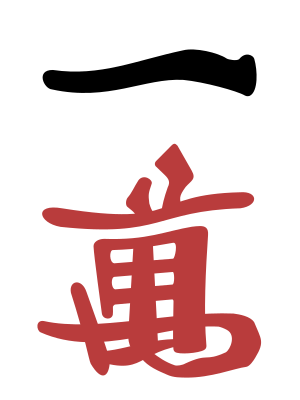
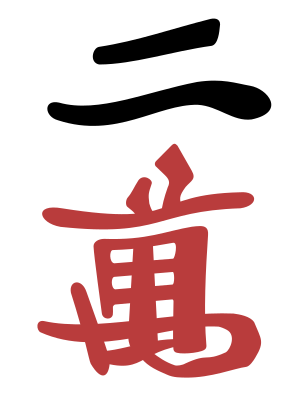
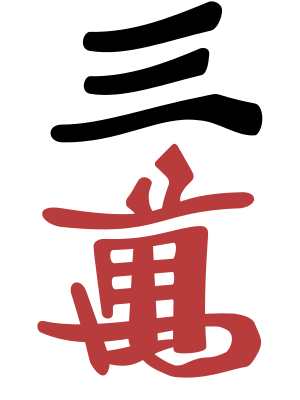
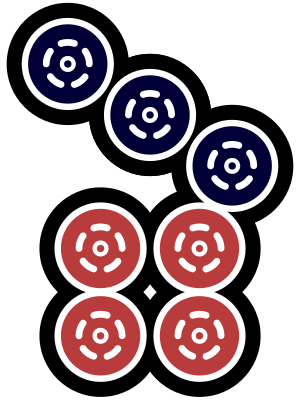

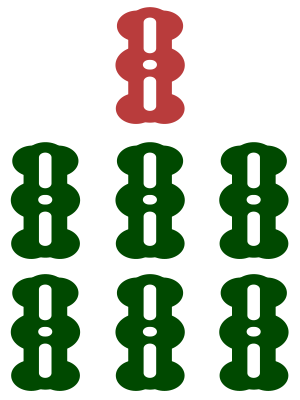

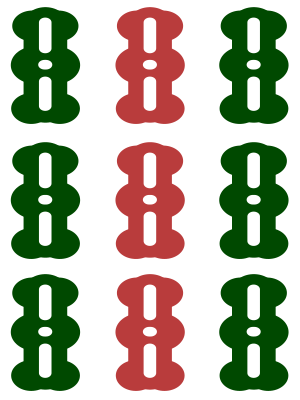
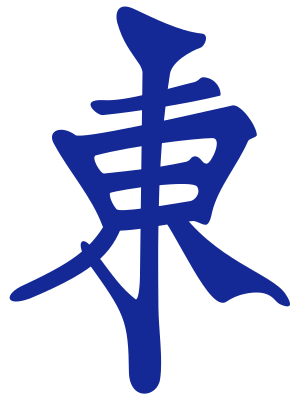
123m 789p 123s 789s 11z
Reveal answer
Every sequence contains a 1 or a 9, and the pair is an honor. Chanta requires every meld and the pair to contain at least one terminal (1 or 9) or honor tile. This shape qualifies open or closed.
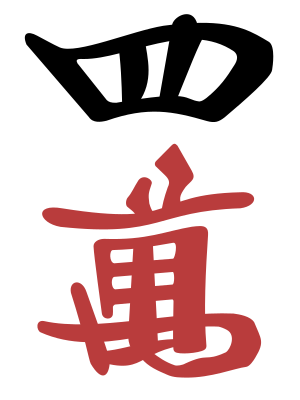
234m 789p 123s 789s 11z
Reveal answer
234m has no terminal and no honor. Chanta is a strict every-group rule — one mid sequence kills it. (789p / 123s / 789s are fine; the 234m is the problem.)
123m 789p 123s 789s 55m
Reveal answer
Every meld contains a 1 or 9, but the 55m pair has neither a terminal nor an honor. Chanta requires the pair to also be a yaochuu pair — 55m alone disqualifies the hand.