



Riichi Mahjong Trainer
Free riichi mahjong study platform — bilingual explainer guides, the full 28-yaku reference, a shanten calculator, a shanten quiz and a points calculator.
A fresh yaku check every day — decide first, then reveal.
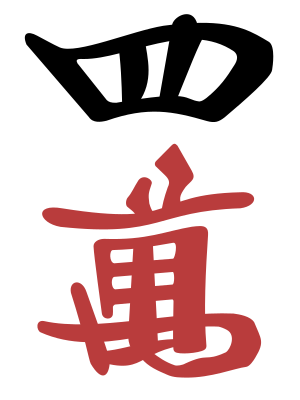
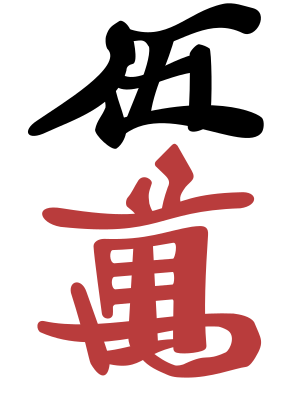
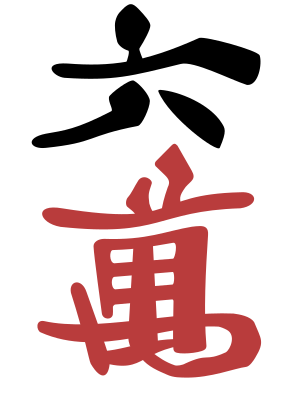
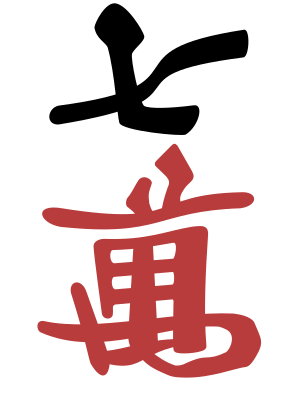
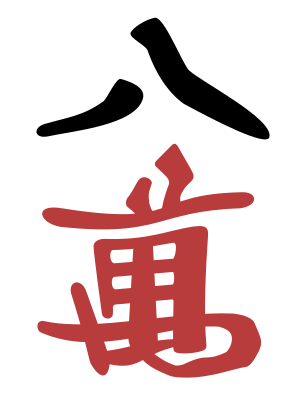
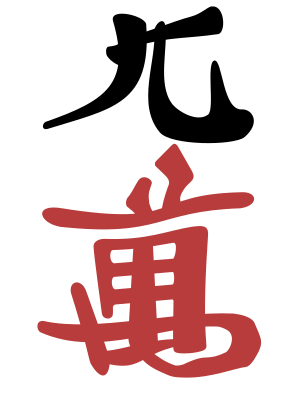

123m 456m 789m 234p 99s
Reveal answer
All three of 1-2-3, 4-5-6 and 7-8-9 appear in manzu, the same suit. The extra 234p sequence and 99s pair complete the hand. Open or closed, ittsu scores.
Read the full explainer →Popular yaku
Browse all →Tsuuiisou (All Honors)
YakumanYakuman. A hand composed entirely of honor tiles — winds and dragons only. Often built around a chiitoitsu shape because honors form pairs more easily than triplets. Stacks with honroutou and (sometimes) shousangen for double yakuman in stricter rulesets.
Honroutou (All Terminals and Honors)
2 HanEvery tile is a terminal (1 or 9) or honor. 2 han. Since terminals and honors cannot form sequences, the hand always pairs with toitoi or chiitoitsu — the resulting stack is typically 4 han or more before dora.
Houtei Raoyui (Last Tile Discard)
1 HanWinning by ron on the very last discard of the round. Companion to haitei (the equivalent last-tile self-draw). Easy to overlook — always recheck waits as the wall empties.
Suuankou (Four Concealed Triplets)
YakumanYakuman. Four concealed triplets in a closed hand. The fourth triplet must complete by tsumo to keep all four concealed — a ron win with a shanpon wait counts the winning triplet as open and downgrades the result to san ankou + toitoi instead.
Ittsu (Pure Straight)
2 HanSequences 1-2-3, 4-5-6 and 7-8-9 all in a single suit. 2 han closed, 1 han open. The same-suit cousin to sanshoku-doujun — vertical inside one suit versus sanshoku's horizontal three-suit spread, and the two cannot coexist.
Ippatsu
1 HanWinning within one go-around after declaring riichi, before any call or kan interrupts the turn. Closed-only by virtue of requiring riichi, and one of the cheapest ways to add a free han to a riichi hand — it stacks freely with everything else riichi unlocks.
What you can do here
Learn the Yaku
Master every scoring hand with illustrated examples and common mistakes.
Shanten Calculator
Analyze any hand and see how far you are from tenpai.
Shanten Quiz
Random 13-tile hand each round — guess how far it is from tenpai across all three winning forms.
Points Calculator
Turn han, fu, role and win type into the canonical riichi payout — including the per-player breakdown.
Where to start
Four short paths through the site — pick the one that matches where you are in your riichi journey.
Start with the basics
Understand what tenpai means, declare riichi to lock in your hand, and see how calls change the rules of the road.
How to declare riichi →Learn the scoring patterns
Browse 28 yaku organised by han value, then see how dora multiplies the value of every winning hand.
Browse all yaku →Practice reading hands
Random 13-tile hand each round. Guess how far it is from tenpai, then see the breakdown across all three winning forms — fastest way to train your eye.
Open the shanten quiz →Analyze a hand you're stuck on
Type or click in a 13-tile hand from your own game and the shanten calculator shows exactly how far you are from tenpai under standard, chiitoitsu and kokushi.
Open the shanten calculator →Common questions
Is riichi mahjong hard to learn?
The basic flow is simple: draw a tile, discard a tile, try to assemble four melds and a pair. The deeper part is learning yaku and reading opponents' discards — and that is exactly what this platform helps you train.
How long does a game of riichi mahjong take?
An East-only round (tonpuusen) is about 30-40 minutes; a full East-South round (hanchan) runs 60-90 minutes. The shanten calculator and yaku reference are designed to fit between rounds when you want a quick review.
Do I need to know all 28 yaku to play?
No. Start with the high-frequency 1-han yaku — riichi, tanyao, yakuhai and pinfu cover the majority of wins. The yaku list groups every pattern by han value so you can drill the basics before tackling yakuman.
How is riichi mahjong different from Chinese mahjong?
Riichi is the Japanese ruleset: fixed scoring patterns (yaku), the riichi declaration, dora bonus tiles, and a clear self-draw / discard-win distinction. Chinese variants (national standard, Sichuan, Cantonese) differ in scoring rules, allowed melds, and whether yaku are required at all. This site focuses on the Japanese rules.