What is Sanshoku Doujun? Riichi Mahjong's Three-Color Straight
Sanshoku doujun (三色同順) is the 2 han yaku for a winning hand that contains the same sequence in all three number suits — for example, 234m + 234p + 234s. It is the textbook mid-tier yaku — common enough to spot every couple of games, but with a built-in 1 han cost when you call.
What is sanshoku doujun?
Sanshoku doujun (三色同順, literally "three colors same sequence") is a riichi mahjong yaku scored when the hand contains the same three-tile sequence in all three numbered suits — manzu, pinzu and souzu. Example shape: 234m + 234p + 234s plus one extra meld and a pair. Closed it is worth 2 han, open it drops to 1 han.
What does opening the hand cost?
Sanshoku doujun is one of the canonical "open downgrade" yaku — it loses exactly 1 han the moment you call. A closed hand with riichi + sanshoku is 3 han before dora; the same shape after one chi is sanshoku 1 han only, since riichi is unavailable. The 1-han downgrade applies to any call: pon, chi, daiminkan or even an ankan (because the kan replaces the would-be sequence with a quad). The cleanest way to keep the 2 han is to build sanshoku entirely from draws and only declare on the winning ron or tsumo.
Sanshoku doujun vs sanshoku doukou — what is the difference?
Sanshoku doujun uses three identical sequences; sanshoku doukou (三色同刻, "three colors same triplet") uses three identical triplets. Doukou is a 2 han yaku that does not downgrade when open. Doukou is much rarer because triplets demand three of a kind in each of three suits — typically built around a single number like 555m + 555p + 555s with one extra meld and a pair. Names look alike; structures are completely different.
What yaku does sanshoku doujun stack with?
Sanshoku doujun combines freely with most yaku that do not exclude its three-suit shape. Common stacks: riichi, pinfu (the three sequences are usually ryanmen-friendly), tanyao (when the sanshoku lives on 2-8 ranks like 345 or 567), iipeiko (rare but legal — the iipeiko pair lives in a fourth meld inside one of the three suits), ittsu (also rare, requires careful hand-building), and the dora family. It cannot coexist with honitsu or chinitsu (which require a single suit), toitoi (no sequences), or sanshoku doukou (different shape).
When should I commit to sanshoku doujun?
The trigger is seeing two of the three suit-pieces already in your starting hand or early draws — for example, 234m and 234p with a 4s nearby. Commit when (1) the third suit's sanshoku pieces are realistically reachable, meaning the connecting tiles are live and not heavily discarded, and (2) the cost of waiting for the third sequence is not worse than the alternative simpler yaku you could go for. The 2 han closed value plus dora often beats a faster pinfu-only hand, especially as a dealer. Open hands lose 1 han, so calling for sanshoku is mostly worth it only when paired with another open-friendly yaku like tanyao or honitsu.
Train the pattern
Look at each hand and decide before revealing the answer.
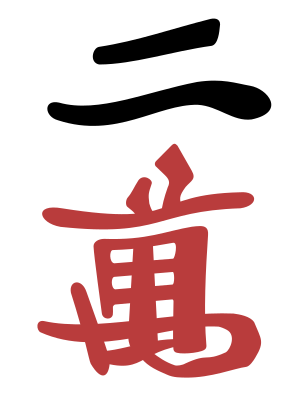
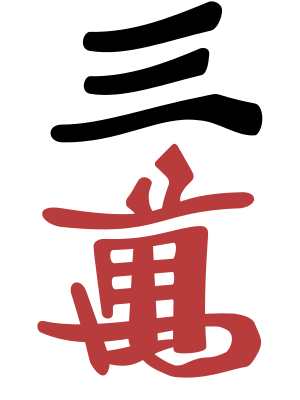
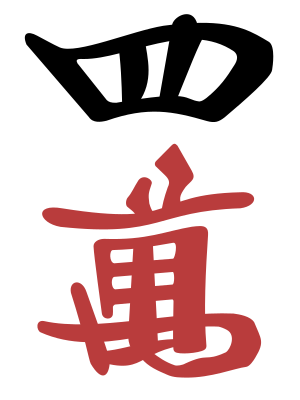
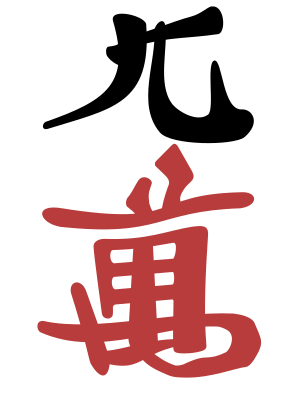
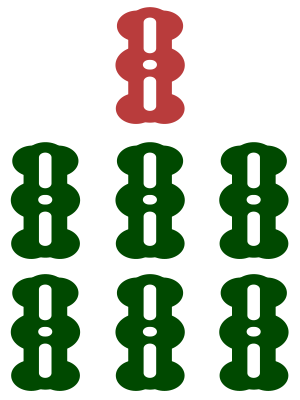
234m 234p 234s 567s 99m
Reveal answer
The same 234 sequence appears in all three numbered suits. Open or closed, the shape scores sanshoku doujun (2 han closed, 1 han open).
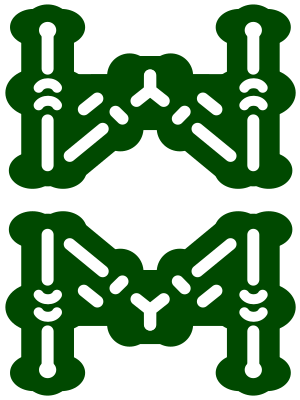
234m 234p 345s 678s 99m
Reveal answer
Manzu and pinzu both have 234, but souzu has 345. Sanshoku doujun requires all three suits to share the same starting number. One mismatched suit kills the yaku.
234m 234p 567s 678s 99m
Reveal answer
234m and 234p match, but no 234s appears in this hand. Sanshoku doujun is binary: all three or none. Two matching suits is just a shape coincidence.