What is Iipeiko? Riichi Mahjong's Pure Double Sequence Yaku
Iipeiko (一盃口) is the 1 han closed-only yaku for a winning hand that contains two literally identical sequences in the same suit — for example, two copies of 234m. It is easy to miss, and easy to confuse with its 3 han cousin ryanpeikou.
What is iipeiko?
Iipeiko (一盃口, literally "one pure sequence") is a 1 han yaku scored when a closed hand contains two literally identical sequences — same suit, same three numbers. The textbook shape is 112233m, which decomposes as two copies of 123m. Both sequences have to be uncalled; iipeiko is a closed-only yaku and any call kills it outright.
What are iipeiko's exact conditions?
Three rules stack: (1) the hand must be fully closed — any pon or chi forfeits iipeiko, and most rule sets treat an ankan the same way because it splits the would-be sequence into a quad; (2) the two identical sequences must share the same suit (both manzu, both pinzu or both souzu — honors cannot form sequences in the first place); (3) the sequences must be literally identical, not just "same numbers in different suits." 123m + 123p is sanshoku-doujun, not iipeiko.
Iipeiko vs ryanpeikou — what is the difference?
Iipeiko is one pair of identical sequences for 1 han; ryanpeikou (二盃口, "two pure sequences") is two separate pairs of identical sequences for 3 han. A hand like 112233m + 445566p contains two iipeiko-shaped pairs (one in manzu, one in pinzu) and scores ryanpeikou instead — the two yaku do not stack, ryanpeikou simply replaces iipeiko whenever the shape qualifies. Ryanpeikou implies a seven-pairs decomposition, and most rule sets forbid scoring iipeiko twice for exactly this reason.
What yaku does iipeiko stack with?
Iipeiko combines freely with most yaku that do not require its sequences to behave differently. Common pairings: riichi, pinfu (the iipeiko sequences are ryanmen-friendly so pinfu often coincides), tanyao (when the iipeiko shape lives on 2-8 ranks), sanshoku-doujun (rare but legal — the same-numbered sequences across three suits plus an extra iipeiko pair in one of them), honitsu and chinitsu. It cannot stack with ryanpeikou (which subsumes it) or toitoi (which forbids sequences).
Why does iipeiko require a closed hand?
Allowing calls would let a player chi tiles directly into the second copy of a sequence they already hold, turning iipeiko into an easy 1 han for any open hand. Iipeiko's purpose in the scoring table is to reward a coincidence — a closed shape that happened to land on two identical sequences — not to mechanically pad open hands. Keeping it menzen-only also tracks the historical lineage: iipeiko, ryanpeikou and the chiitoitsu family are all the small-pattern Japanese additions to a much older scoring catalogue and they all share the closed-only rule.
Train the pattern
Look at each hand and decide before revealing the answer.
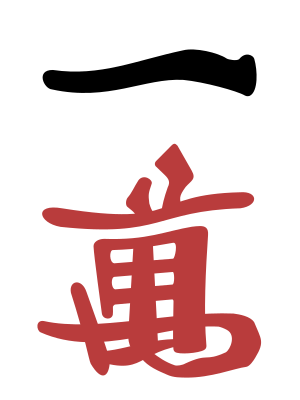
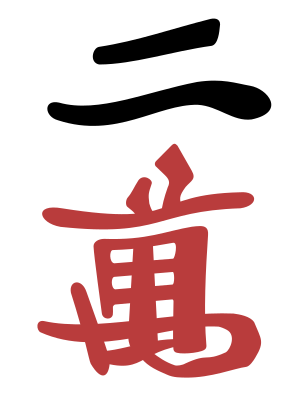
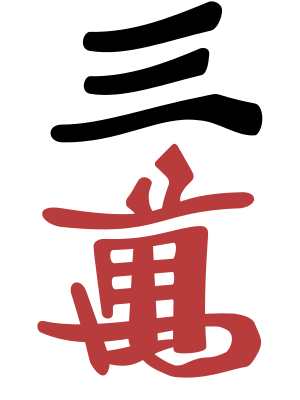
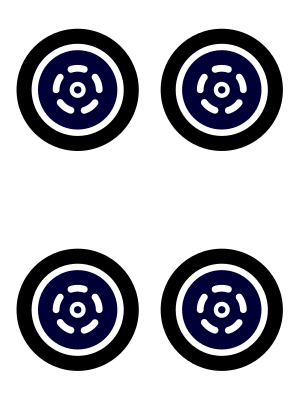
112233m 456p 678s 99s
Reveal answer
The 112233m block decomposes as two copies of 123m — two literally identical sequences in the same suit. Closed-only; if the hand were opened by any call, iipeiko would fail.

123m 123p 456s 789s 99s
Reveal answer
123m and 123p are the same numbers in different suits. Iipeiko requires the two identical sequences to share a suit. Same-number-across-suits scores sanshoku doujun once a third matching suit appears.
112233m 445566p 99s
Reveal answer
Two pairs of identical sequences (123m × 2 and 456p × 2) scores ryanpeikou for 3 han. Most rule sets do not let you also count iipeiko — ryanpeikou replaces it rather than stacks.