Chiitoitsu (Seven Pairs)
A closed hand of exactly seven distinct pairs. The seven pairs must all be different tiles — duplicates of the same pair count as one. Scores a flat 25 fu and pairs well with honor-heavy or mixed-suit hands that resist forming triplets.
Read the full explainer →Example hand
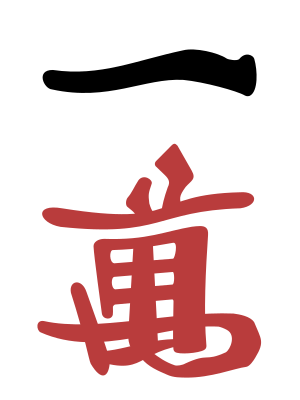
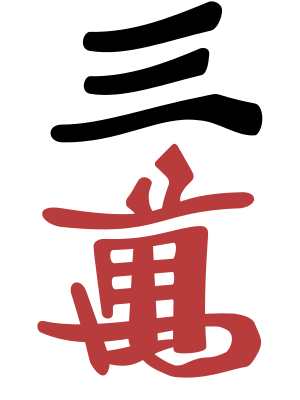
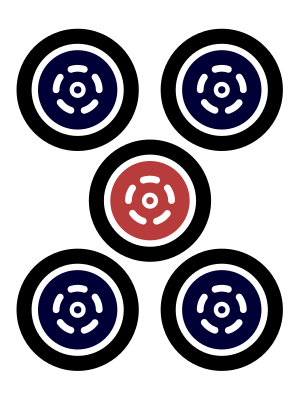
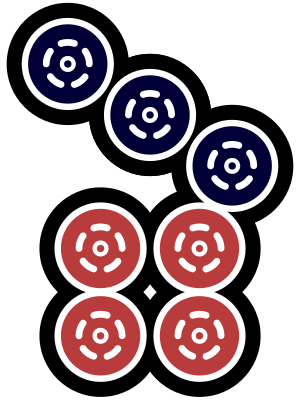
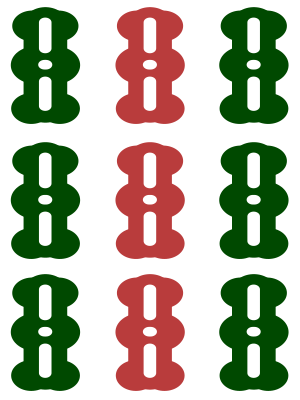
11m33m55p77p99s22z44z
Open in shanten calculator →Related yaku
Ryanpeikou (Two Pairs of Identical Sequences)
3 HanA closed hand containing two separate pairs of identical sequences (two iipeiko shapes). 3 han, closed-only. Mathematically a chiitoitsu shape, so most rulesets do not let a hand score iipeiko twice instead — ryanpeikou simply replaces the would-be 2 han stack.
Iipeiko (Pure Double Sequence)
1 HanTwo identical sequences (e.g. two 234m) in the same suit, in a closed hand. 1 han, closed-only — any call kills it outright. Replaced by ryanpeikou (3 han) when the hand contains two such pairs of identical sequences.
Tanyao (All Simples)
1 HanA hand containing no terminals (1s, 9s) and no honor tiles — only 2-8 of suits. 1 han, open or closed under modern kuitan rules; strict rulesets still require menzen. The workhorse open yaku, easy to lock in whenever the early hand is heavy on middle tiles.
Honitsu (Half Flush)
3 HanA hand containing only one numbered suit plus honor tiles. 3 han closed, 2 han open. The workhorse high-value open yaku — combined with a yakuhai triplet it routinely clears mangan even after multiple calls.
Tsuuiisou (All Honors)
YakumanYakuman. A hand composed entirely of honor tiles — winds and dragons only. Often built around a chiitoitsu shape because honors form pairs more easily than triplets. Stacks with honroutou and (sometimes) shousangen for double yakuman in stricter rulesets.